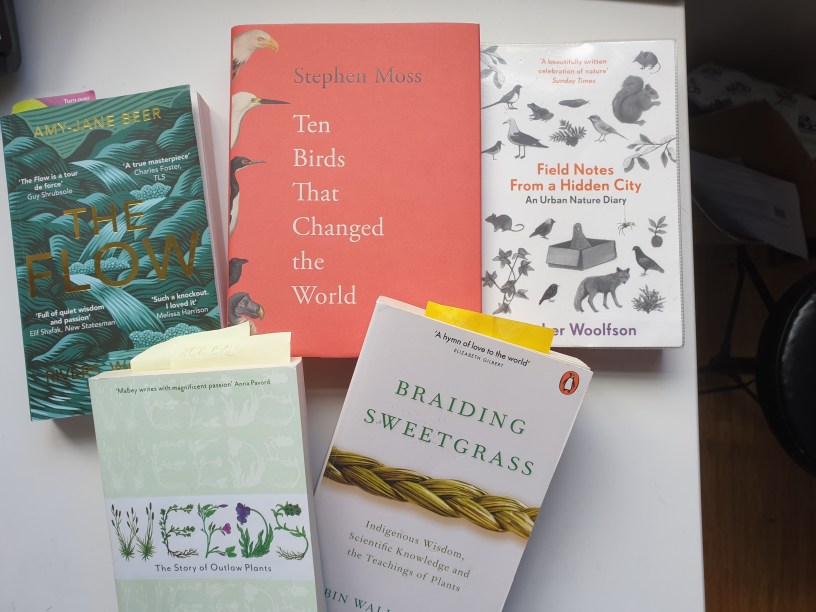
The other tutors and I have been compiling our favourite books to share with our new intake of MA nature & travel writing students. I’ve finally settled on my (current) 5 favourite nature-writing books, some new and some old faithfuls I keep going back to. The list reflects my preference for nature writing books which are often beautifully and lyrically written but are underpinned by a deep knowledge of the natural world, precision and rigorous research.
- The Flow – Amy-Jane Beer 2022: I’m currently reading this, the first creative nature-writing book from one of my favourite nature writers, is gorgeous – lyrical and precise, curious and analytical. It draws on Amy’s extensive knowledge of biology and the natural world and we sense she has considered every word she uses. We join Amy as she starts to come to terms with the loss of a friend while exploring waterways of the British Isles.
- Field Notes from a Hidden City – Esther Woolfson 2013: The premise of this book is simple, a year’s worth of diary entries from the author’s observations of nature in and around Aberdeen, and the questions about our attitudes to nature which these observations spark. It’s a beautifully written example of urban nature writing and both joyful and heartbreaking in equal measure.
- Ten Birds that Changed the World – Stephen Moss 2023: What can I say other than it was very hard to decide which book of Stephen’s to choose, as there are so many that I love. But this one has a great angle, is a winning combination of elegant writing, natural and social history, interesting conversations and firsthand observations. I may be biased, Stephen’s a friend and mentor, but I think this one is genius.
- Weeds – Richard Mabey 2010: From the master of plant writing , this book weaves close observation with an exploration of our attitudes to some of the interesting and opportunistic plants which have followed in the footsteps of humans. His enthusiasm for the overlooked aspects of nature is utterly infectious and he really knows how to tell a good yarn. This is a book I repeatedly dip in to.
- Braiding Sweetgrass – Robin Wall Kimmerer 2013: An extraordinary book from this US scientist which blends wonderful first-hand observation and accounts of working with plants with science and First Nation mythology. The writing is delicious and her attention to detail is meticulous. Another book I repeatedly return to.
 Freelance Nature Writer
I love all of those, especially ‘Braiding Sweetgrass’, but I hope you’ll get a chance to read ‘Windswept’ by Annie Worsley. Annie is my friend so I may be biased, but the book combines her knowledge of geography and landscape (she was a Prof of geography) with superb creative nature writing. Some of her descriptions are superb.
LikeLiked by 1 person
Thanks for the tip Jen!
LikeLike