[Author’s note – I’d very much welcome readers’ comments on this blogpost.]
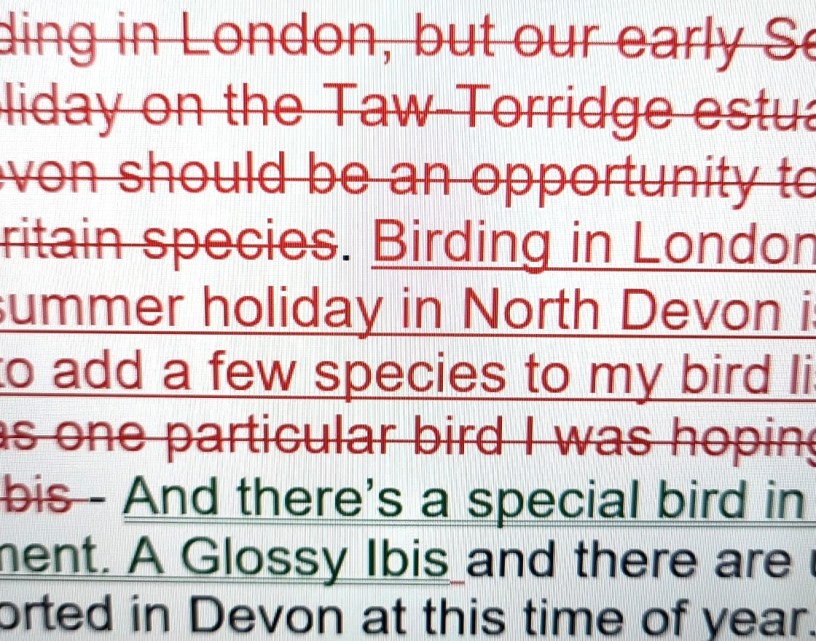
The difference between ‘nice‘ and ‘great’ creative nature writing often comes down to the quality and thoroughness of editing carried out after the first draft has been written. The usual rule of thumb I suggest to participants in my writing workshops is to expect to spend at least twice as much time editing and polishing as you do draft. As I meet each group of new writers, I can usually see that some are sceptical. There may be a perception that really good writers should just be able to write streams of beautiful prose straight off, and that writing process should be easy. If my sceptics suspend disbelief and really commit to developing an editing process which works for them, they frequently begin to produce really well-written, compelling nature writing. Other sceptics are harder to persuade; their writing may be ‘nice’ but they never manage to push it up to the next level. The bottom line is that creative writing is both fun and hard work. In this article, I hope to persuade you of the value of focussed editing to achieve that step-change in your writing, and I’ll suggest an approach you could take.
Let’s imagine that you’re going on a walk for a dose of nature. You have perhaps taken a few written notes, made an audio recording or snapped a few memo photographs. On your return you use your research notes to write a short narrative account – perhaps around 100 words – describing a memorable aspect of the natural world you experienced on your walk. If you’re doing this to use as a nature diary entry, for example, just correcting typos and checking for missing words may be enough.
If, on the other hand, you want your notes to form the basis of a polished piece of creative nature writing, then a more substantial editing process is needed. Let’s imagine that the end objective is an ultra-short-form piece of writing – ‘thumbnail nature’ – of 50 words maximum which shows off your nature writing skills and wordsmithery in miniature. Short pieces of writing like this are both fun to do and handy for practising writing skills which can be extrapolated to longer pieces of writing.
There isn’t just one way of going about editing your own writing, but, unless you already have an approach you like to use, here’s a step by step process you could use.
A) At the outset, it’s a good idea to settle on a structure and chronology for your piece of writing to achieve the desired narrative arc. To be really compelling, your thumbnail is very likely to need a compelling highpoint to structure it around. A walk in which nothing much happens makes this harder, but sometimes revelations which occur to you can be used for good purpose.
B) First and last sentences are really, really, really important. You want to grab your reader from the outset and then leave them satiated by the end, albeit itching to find some more of your wonderful writing.
C) Focus deliberately on language & syntax: i.e. rhythm, verb choice, specificity, cliché-busting etc. Do make conscious word/phrase choices while making sure that you retain clarity.
D) Read aloud at least twice to check for rhythm, readability & repetition. Then re-edit and polish your pice. The rule of thumb is to ‘Write once, edit twice.’
Let’s explore what these editing steps could actually entail.
A) Structure and chronology
Narrative arc is the structural backbone of a ‘story’ whether fiction or narrative non-fiction, outlining the chronological progression from beginning to end. Book- or essay-length narrative non-fiction writing could include as many as five stages: the set-up of essential background and context (exposition), rising action, the high point (climax), falling action, and resolution. In ultra-short-form narrative non-fiction, like thumbnail nature writing, these stages may have to be truncated to just set-up, high point and resolution.
There are some common ‘high point’ types in short-form nature writing as follows:
- A momentary event, for example a spider pounces on a moth.
- Something is revealed to the reader, for example the ‘teenager’ you’re writing about is a young fox.
- A surprising realisation of your own, for example you realise that the lump of wood you’ve overlooked is a roosting nightjar.
Even in thumbnail nature pieces, with three key elements – set-up, high point, resolution – there are at least six ways you could structure your piece. I’m going to explore three of these in more depth:
- Set-up, build-up and high point, resolution.
- High point, back to set-up and build-up, jump forward to resolution.
- High point, Resolution, back to build-up and set-up.
Here are some examples of how these structures could be used in ‘thumbnail nature’ writing. Have a go working out which bits of text relate to which part of the structure.
- Set-up, build-up and high point, resolution – ‘Suburban high noon. Grass alley between garden fences. At one end, a fox. At the other, two crows forage all casual-like, their nest in a sycamore overhead. Fox inches forward. Stops. Starts. Watched every step. Nah, not worth it mate. He turns and lopes away. I breathe out gently’
- High point, back to set-up build-up, jump forward to resolution: “Yes, yes, YES!” as I fling myself onto the ground at the foot of an oak. This is passion, but possibly not the kind you’re now imagining. A tiny, lushly-hairy tawny mining bee skirts the spoil; with marmalade abdomen & rich amber thorax. True love.
- High point, resolution, back to build-up and set-up: There’s a sprite in the garden! A peripheral blur on the wall-breaking valerian, pinging from pink to pink. This humming, hawking summer visitor – so full of energy and verve – punctures my doldrums. Most years, the doldrums and these hawkmoths return, just as the days start to cool and shorten.
While you’re working on a piece of thumbnail nature, do play around with structure and ordering of the key elements of your piece, to try out what achieves most impact before moving on to…
B) Grab your reader from the outset and leave them satiated. Openings & closings really matter
I can’t overemphasise how disproportionately important are the openings and closing of pieces of writing of any length. A quick scan of some key nature writing books illustrates the thought which the authors have put into them. Here are some interesting examples I found:
- Robert Macfarlane’s, Wild Places, opens with: “The wind was rising, so I went to the wood.” And closes with: “But at that moment the land seemed to ring with a wild light. The opening suggests he is compelled to set off for the wood as he is to all the ‘wild places’ in the narrative, and the book closes with vision-like image of landscape.
- Michael Malay’s, Late Light, opens with: “A narrow lane in southern England, on one of the longest days of the year.” And closes with “The last clouds descend, the pool darkens, and then – just like that – the birds are gone.” The opening is a cleverly succinct set-up, and the book closes with a sense of loss which echoes a core theme of the book.
- Chapter 1 rather than the prologue of Chloe Dalton’s, Raising Hare, opens with “Standing by the back door, readying for a long walk, I heard a dog barking, followed by the sound of a man shouting.” And closes with “I will remember her leaving, but will know that before she did, she always, first, looked back.” The book opens with a sense of foreboding. The final sentence is a little clunky, but does draw the book’s theme of the relationship between human and wild animal to a close.
Once you’ve written your first draft for a piece of thumbnail nature, and then decided how to structure your piece, spend some time getting the opening and closing sentences as sharp as possible, before applying that level of focus to the rest of your piece…
C) Language and syntax – focusing here on rhythm, verb choice & specificity in each sentence.
There’s a lot to unpack in the application of language and syntax, so here I’m just going to focus here on three aspects: rhythm, verbs and specificity.
Make use of rhythm. A satisfying rhythm which helps the reader focus on the high point in a piece of writing can sometimes be achieved by varying sentence length and choice of phrases, and something which we prose writers have much to learn from our poet friends. A small tweak can make a considerable difference. In Stephen King’s 2023 novel, Holly, one of the characters – a poet explains this to a poetry student. The student has been told to change the line from (a) to (b) below by a university lecturer.
a) “This is the way the birds stitched the sky closed at sunset.”
b) “This is how the birds stitched the sky closed at sunset.”
The poet tells the student to read them aloud to hear how different the rhythms and suggests that (a) works much better in the context of the woman’s poem. Try reading them aloud yourself. I find (a) much easier and more satisfying to read.
Reading poetry can illustrate you see the impact of sentence lengths and phrases, and you can borrow this for your prose. Reading your own work aloud is the best way of hearing the rhythm and whether it helps or hinders the communication of your message.
Use verbs to do the heavy-lifting. I confess I have an antipathy towards adverbs. They’re frequently the words which make a piece of writing feel overwritten. Our language is so rich in fantastic verbs that it’s rare that we need to resort to using adverbs to explain an action. The sentence (c) below is typical of one in a first draft in which the writer wanted to get the action down on paper and not worry too much about the choice of words. There’s nothing really wrong with this, but it does lack impact.
c) “I walk slowly along the lake shore, carefully looking for plants growing between the boulders.”
Rewriting (c) using verbs which can really do some heavy-lifting might lead the writer coming up with (d). It’s punchier and each word is earning its place.
d) “I wander the lake shore, scrutinising the plants clinging between the boulders.”
In a short piece it’s relatively easy to practise working those verbs, but this level of attention to detail needs to be applied in any piece of creative prose, of whatever length.
Be specific. Being specific and precise about what you’ve seen, heard, felt, smelt or even tasted in the natural world helps your reader stand shoulder to shoulder with you in the piece. Finding out the names of plants, animals and fungi you reference and using the names of people who appear are worthwhile. And while it’s particularly important in writing compelling nature writing, it is important for other types of creative non-fiction too. Look at example (e) below, and then how much more convincing (f) is.
e) “A man quietly mimics the bird’s call, making the sound with his mouth.”
f) “Arjun pishes at the sedge warbler, expelling air between lips and teeth.”
As one of student’s once put it, “You don’t have to know a lot about nature to write about nature, but it does seem strange if you’re not interested in finding out more about it.” If you don’t know the names of things you see, find experts to help you. You do need to do your research.
D) One of the final stages of editing is to read your piece aloud to engages your hearing as well as your sight in the editing process. Reading aloud is particularly good for checking rhythm, as already mentioned, but also the general readability of a piece, and to identify unwanted repetition.
It’s not the same if you just mouth the words: you really need to shut yourself in a room with no interruptions so you can hear the words as you read them. Listen to the rhythm. You’ll also notice which bits are hard to read aloud and may need some rethinking of phrasing or punctuation. And you’ll probably spot where you’ve unintentionally used the same word several times.
Summary
Editing is fundamental to great creative nature writing, and you need to set aside enough time – remember write once, edit twice – to do it. In time you’ll probably develop a slick process which works for you. Nature writers who inspire me aren’t the ones for whom beautiful prose seems to simply stream from their keyboards, but those whose deliberative, intensive and focussed editing process produces writing which appears effortless to the reader.
In this article I’ve explored the editing process with an ultra-short-form piece of nature writing, but the principles and process I’m suggesting apply equally to nature writing of any length. It may seem daunting to think of taking such a detailed approach in editing, but you will get quicker at doing it with practice and the results will really pay off. We know what “This is a nice piece of nature writing...” means and how much more gratifying it would be to have your writing described as “Vivid and compelling nature writing in which every word earns its place.”
 Freelance Nature Writer
Dear Amanda,
Thank you so much for sharing your refined advice: it’s much appreciated and very inspiring especially as I’ve recently had an itch to try to practise writing again. You are very generous.
Warm wishes,
Rachel
LikeLike
Good to hear from you Rachel. Hope you’re well and wishing you all the best with your writing. Amanda
LikeLike